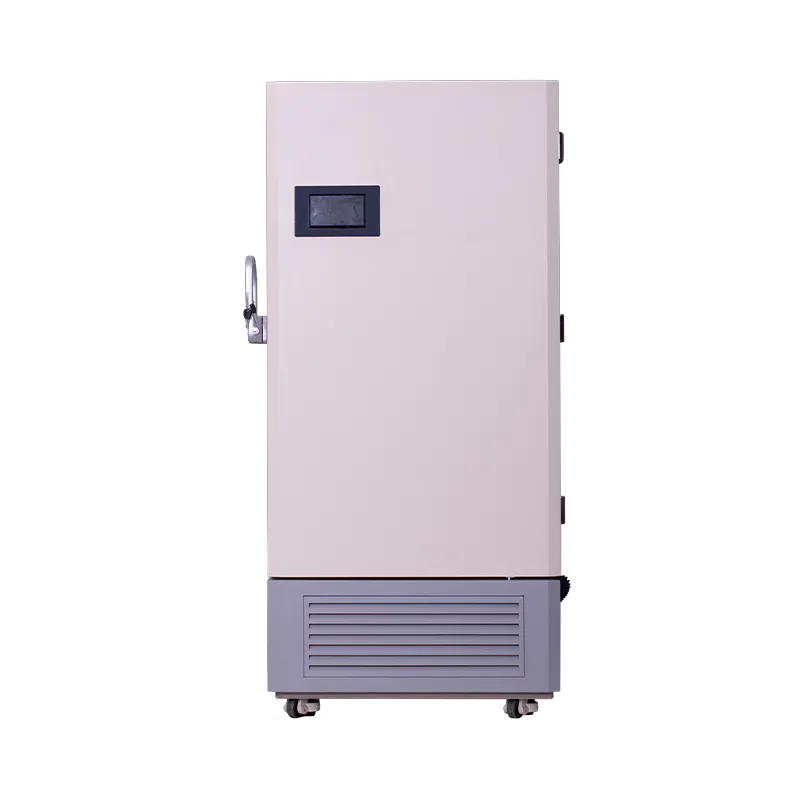
Short answer: procure an ultra-low temperature freezer from the storage task, validated operating range, real box-and-rack load, site heat and power constraints, monitoring design, failure response, and acceptance evidence—not from nominal litres or a lowest-temperature claim alone.
Start with the material, not the freezer catalogue
Before comparing cabinets, the storage owner should define what will be stored, its approved temperature range, package format, maximum allowable excursion, access frequency, retention period, and consequence of loss. Research samples, reference materials, biological products, reagents, and vaccine-related materials may have different requirements. The freezer supplier can explain equipment performance, but the material owner and the organization’s quality process must approve the storage condition.
Do not treat “-86°C freezer” as a complete specification. It may describe an adjustable setpoint, a nominal platform, or the lowest selectable value. The RFQ should state the required operating setpoint and acceptable cabinet-temperature limits, then ask for evidence at that condition and at the intended room ambient.
1. Build a comparable RFQ baseline
| Buyer input | What to define | What the supplier should return |
|---|---|---|
| Storage task | Material, approved range, excursion decision owner, expected storage period | Exact model and configuration proposed for that task |
| Load | Box, rack, vial or container dimensions; routine and peak quantity | Dimensioned internal layout and usable capacity |
| Operating profile | Setpoint, door openings, additions, access pattern, growth period | Relevant performance evidence and loading instructions |
| Site | Ambient range, ventilation, altitude if relevant, voltage, frequency, backup supply | Installation limits, electrical data, heat-rejection data, clearances |
| Monitoring | Independent sensor, records, alarm route, retention, calibration policy | Interfaces, accessories, sample exports, alarm and backup behaviour |
| Acceptance | Factory checks, site checks, mapping or verification, pass criteria | Test protocol, instruments, reports, training and handover scope |
Issue the same table to every bidder. A quotation that omits a requested value should remain visibly incomplete rather than receiving the same score as a documented response.
2. Convert nominal capacity into a rack-and-box layout
Cabinet litres do not show how many real samples fit. Record the outer dimensions and required orientation of each box, rack, tray, bag, or container. Include dividers, labels, security separation, quarantine stock, and space needed for safe handling. Request clear internal dimensions and the dimensions of shelves, compartments, and inner doors for the exact configuration.
- Use the peak load: include the largest expected delivery, project expansion, and any approved reserve.
- Protect airflow and sensing: follow the model-specific loading limits around internal walls, ducts, probes, and doors.
- Plan retrieval: frequently accessed material should not require staff to search through several racks with the outer door open.
- Check ergonomics: assess rack weight, shelf height, frost, gloves, labels, and the ability to remove containers safely.
- Keep an inventory map: a defined location system shortens door-open time and helps staff identify affected stock during an incident.
Ask each supplier to mark the proposed load on a drawing. This exposes unusable spaces and different rack assumptions before purchase, when corrections are still inexpensive.
3. Verify the room, delivery route, and electrical supply
An ultra-low freezer transfers heat from the cabinet to the room. Request the model’s heat-rejection data under declared conditions and give it to the facilities team. Confirm that room ventilation or air conditioning can support all cold-storage equipment operating together, including seasonal extremes and reduced building operation at night or on weekends. Excess room temperature can affect performance and energy use, so the quoted ambient limit should be checked against measured site conditions rather than a design assumption.
Survey the full delivery route using the crated dimensions and weight: loading area, doors, lifts, corridors, ramps, turns, thresholds, floor loading, final placement, and unpacking space. Obtain the installation drawing and reserve the required clearances for ventilation, door movement, cleaning, and service access.
Have a qualified local electrician compare voltage, frequency, phase where applicable, maximum current, starting behaviour, plug or hard-wiring arrangement, circuit protection, earthing, and backup-power compatibility with the exact model. The freezer, monitoring device, network gateway, and remote notification path may have different power requirements.
4. Request performance evidence under stated conditions
A setpoint and a digital display do not demonstrate temperature performance throughout a loaded cabinet. Ask how the model was tested and request the result that is relevant to the intended configuration. The supplier response should identify the ambient condition, setpoint, load state, sensor number and positions, measurement interval, stabilization period, door-opening method, and calculation used for each reported value.
| Performance item | Buyer question | Important context |
|---|---|---|
| Uniformity or spatial variation | What temperatures were measured at which cabinet positions? | Sensor map, load, ambient, setpoint, measurement period |
| Stability over time | How did temperature vary at each position during normal cycling? | Sampling interval, calculation, defrost or control events |
| Pull-down | From what starting condition to what endpoint? | Empty or loaded state, ambient, power supply, endpoint definition |
| Door-opening recovery | What door opening and recovery endpoint were used? | Duration, number of openings, load, monitored position |
| Warm-up or holdover | What happens after power is removed? | Starting temperature, load, ambient, alarm and monitoring continuity |
Do not compare two recovery or holdover numbers unless their test conditions and endpoints are compatible. Where the organization requires site mapping or qualification, agree the protocol and acceptance limits before ordering rather than assuming that a factory report replaces site verification.
5. Specify monitoring and alarms as independent decisions
Separate the freezer controller, local display, internal records, independent monitoring device, and remote alarm service. For each layer, identify the sensor, operating range, accuracy or uncertainty information, calibration method, sampling interval, memory, export format, clock handling, access control, and behaviour during power or communication failure.
CDC’s vaccine storage guidance notes that not every data logger is suitable for ultra-cold measurement and calls for an air probe or a probe designed for ultra-cold temperatures where that application applies. Even outside vaccine programmes, the procurement lesson is useful: confirm the complete measurement chain at the actual operating temperature, not just the display resolution on a brochure.
Create an event matrix for high and low temperature, door open, power failure, sensor fault, controller fault, communication loss, and low backup battery where fitted. Define threshold, delay, local indication, retained record, remote recipient, acknowledgement, escalation, reset, and test method for each event. Then connect every critical alarm to a written staff response.
6. Compare energy using declared test data
Request daily energy use at a stated setpoint and ambient condition, together with the test method, cabinet volume, and configuration. The current U.S. EPA ENERGY STAR Version 2.0 specification includes ultra-low temperature freezers and evaluates their energy performance under a defined method. ENERGY STAR certification can provide a useful comparable data point for models sold and certified in that programme, but it does not by itself prove suitability for a particular sample, room, country, or acceptance protocol.
Ask facilities to estimate the local operating cost using the documented energy value and electricity tariff. Also compare room cooling demand, refrigerant information, service requirements, filter cleaning, condenser access, expected component availability, and the consequences of operating at a colder setpoint than the material actually requires. Do not claim an energy saving unless the compared values use compatible conditions.
7. Design continuity before the freezer arrives
The continuity plan should cover loss of mains power, refrigeration failure, high room temperature, monitoring failure, communication outage, and access problems. Name the decision owner, alternate storage location, available spare capacity, transfer containers, transport monitoring, contact list, and criteria for moving or quarantining material.
A generator, UPS, alarm battery, and thermal holdover solve different parts of the problem. Record which loads the backup system supports, how long it is expected to operate under approved conditions, how it is tested, and what happens when it cannot start or fuel is unavailable. Alternate storage is useful only if it is compatible, monitored, reachable, and available during the same event.
8. Put the specification into FAT and SAT
| Acceptance stage | Example checks | Record to retain |
|---|---|---|
| Document review | Model, configuration, manuals, drawings, electrical data, test evidence | Approved submittal and deviation list |
| Factory acceptance | Identity, construction, controller, alarms, interfaces, agreed performance test | Signed protocol, instruments, raw data, result |
| Delivery and installation | Damage, placement, clearances, supply, accessories, serial number | Receiving and installation checklist |
| Site acceptance | Startup, stabilization, monitoring, alarms, remote recipients, records | Site test and notification evidence |
| Performance verification | Approved empty or loaded study at the intended setpoint | Temperature data, sensor locations, deviations, approval |
| Handover | Training, SOPs, maintenance, calibration, spares, warranty contacts | Acceptance signature and action register |
Define pass criteria and responsibilities before the purchase order. Do not load critical material while the freezer is merely cooling down or before the responsible team has accepted its monitoring evidence. Use safe alarm and power-failure simulations approved by the supplier and facility; do not create risk to stored material for the sake of a test.
Questions for the supplier comparison
- What exact model, setpoint, ambient range, voltage, shelves, racks, inner doors, probes, and options are included?
- How many of the buyer’s actual boxes or racks fit while respecting the loading instructions?
- Which temperature, recovery, pull-down, holdover, and energy results apply to this configuration, and under what conditions?
- Which alarms and records remain available during loss of mains power or network service?
- What independent monitoring hardware, calibration, software, subscriptions, or gateways are required?
- What room cooling, electrical, ventilation, delivery, maintenance, and spare-part provisions are required?
- Which FAT, SAT, verification, training, and handover activities are included in the quotation?
Move from catalogue comparison to an evidence package
A defensible ultra-low freezer decision links each storage risk to a requirement, supplier response, acceptance test, and operating procedure. The result is more useful than a long feature list because procurement, laboratory, quality, facilities, and service teams can review the same evidence.
Compare the Roundfin ultra-low temperature freezer range, including the 408L and 938L configurations. Use the alarm specification checklist and installation and commissioning checklist alongside the RFQ. For a model-level review, send the required temperature, box or rack load, room conditions, power supply, destination, and monitoring plan.