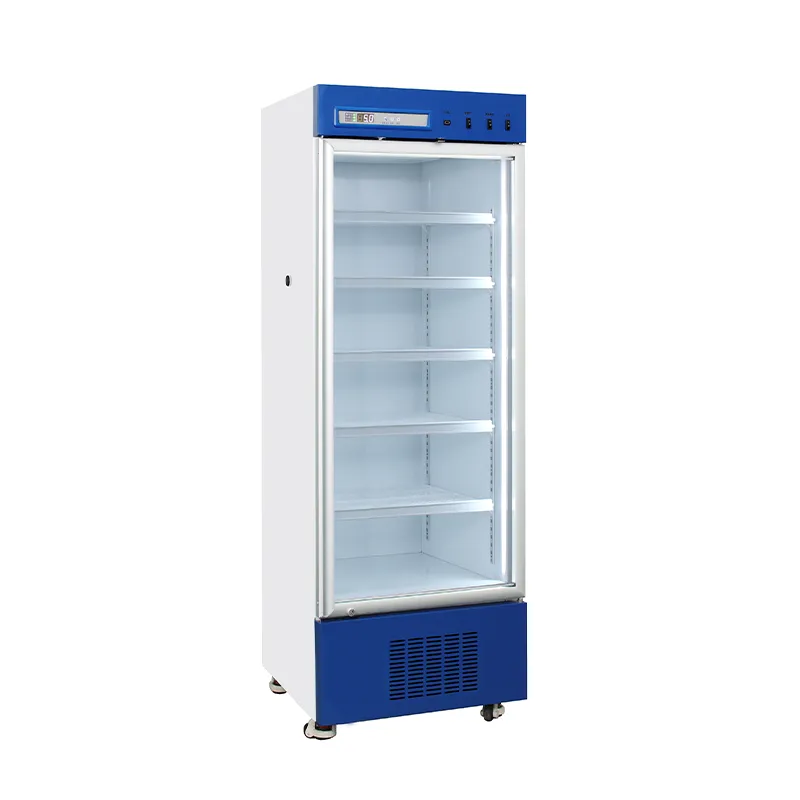
Short answer: a medical refrigerator is not ready for use merely because it has arrived and powers on. Before placing an order, agree who will confirm the delivery route, room conditions, electrical supply, ventilation, monitoring, commissioning evidence, and the point at which stored material may be transferred into the cabinet.
Why installation readiness belongs in the purchase decision
Product comparisons usually emphasize temperature range, capacity, alarms, and price. A site that cannot receive, power, ventilate, monitor, or service the quoted cabinet can make those specifications irrelevant. Treat installation as a separate acceptance stage, with responsibilities assigned to the supplier, facilities team, storage owner, and local service provider before the purchase order is issued.
For vaccine programmes, follow the applicable programme rules and product instructions. The WHO IMD-PQS E003 guidance discusses matching equipment to site climate and energy source, service capability, installation, and user training. The CDC Vaccine Storage and Handling Toolkit also addresses storage-unit placement and stabilization. These vaccine-specific sources are useful prompts for a broader site survey; they do not make every medical refrigerator WHO-prequalified or subject to the same programme requirements.
1. Trace the entire delivery route
Check more than the finished cabinet width. Request the crated dimensions and weight, handling orientation, lifting points, and unpacking instructions for the exact model. Measure loading-bay access, doors, lifts, corridors, turns, ramps, and the final room entrance. Confirm floor-load limits and whether specialist lifting equipment or permits are needed.
Agree who receives and inspects the shipment, how visible damage is documented, where packaging is removed, and who moves the unit into its final position. Do not assume a freight delivery includes placement, installation, or removal of the old cabinet.
2. Measure the room under realistic conditions
Record the room's expected minimum and maximum ambient temperatures, including nights, weekends, seasonal extremes, and air-conditioning outages. Compare these with the quoted model's rated ambient range and the conditions under which its temperature performance was measured. Assess direct sunlight, moisture, dust, nearby heat sources, and access for cleaning and maintenance.
Obtain the model-specific installation drawing. Reserve its required clearances around vents, condenser, doors, and service panels; do not apply a universal clearance number to every design. Verify the door swing and usable working space with nearby furniture in place. For vaccine units, consult the storage-unit placement section of the current CDC toolkit and the manufacturer manual.
3. Confirm power and outage arrangements
Have a qualified local electrician confirm the available voltage, frequency, plug or connection type, circuit capacity, protective devices, and earthing against the model's installation instructions and local electrical rules. Clarify whether the unit, logger, gateway, and alarm notifications remain operational during a power failure. A controller battery, a building generator, and an uninterruptible power supply solve different problems; request evidence for the exact configuration rather than assuming backup runtime.
Assign responsibility for power-failure escalation and alternate storage. The storage owner should approve the transfer plan for the actual material, including transport containers, monitoring, contacts, and decision authority.
4. Specify commissioning before the first load
| Checkpoint | Evidence to keep | Owner to agree |
|---|---|---|
| Delivery and placement | Model and serial number, damage check, final location, level and clearance check | Receiver, installer, facilities |
| Power and startup | Supply check, installation record, startup instructions followed | Qualified installer or electrician |
| Temperature performance | Stabilization records and an agreed monitoring or mapping method appropriate to the load | Storage owner and quality team |
| Alarms and records | Safe functional checks, recipient list, sample export, time setting | Installer and monitoring owner |
| Handover | Manuals, training, maintenance contacts, warranty terms, accepted deviations | Supplier and facility |
The acceptance period and pass criteria should be agreed in advance for the stored material and governing procedures. Do not load temperature-sensitive inventory while the unit is merely cooling down or before the responsible team has accepted its monitoring record. CDC's toolkit describes a stabilization process for vaccine units; other applications should use their own approved protocol and product instructions.
5. Put these questions in the RFQ
- What are the crated and installed dimensions, weights, handling limits, and required delivery access?
- What ambient range and clearances apply to this model, and what performance evidence supports the intended site?
- What electrical supply and protection does the exact configuration require?
- Which party installs the cabinet, monitoring devices, network connection, and any backup-power interface?
- What startup, stabilization, alarm, and record checks will be demonstrated before acceptance?
- Who trains users, provides local service and spare parts, and signs the handover?
Use the site survey alongside the usable-capacity planning guide and the alarm specification checklist. Compare the medical refrigerator range, then send the model, destination, room conditions, power supply, and intended load for a configuration discussion.