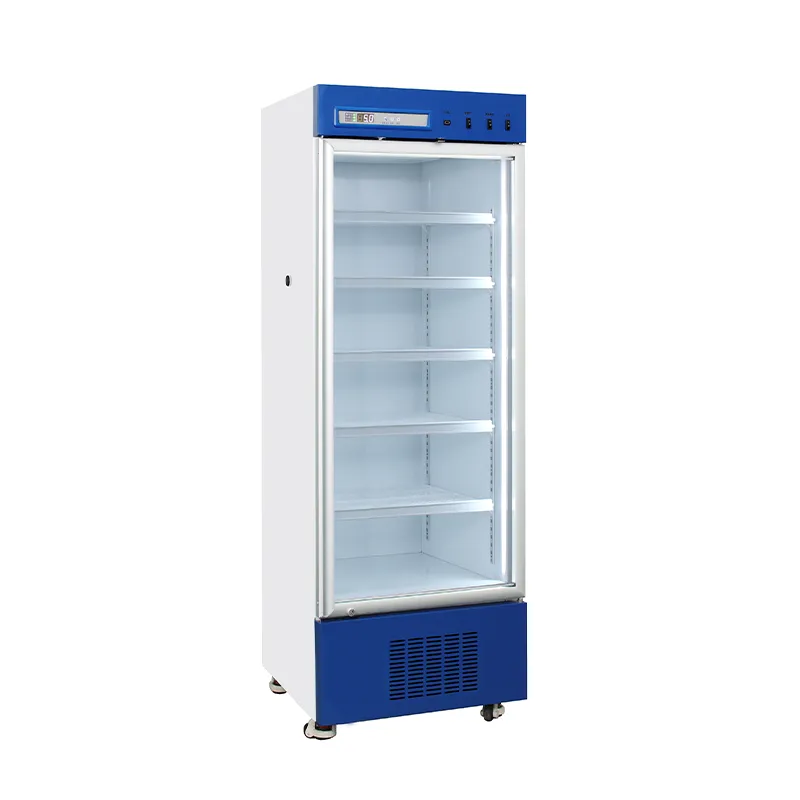
Short answer: temperature mapping should prove where the planned load can be stored, under defined operating conditions, before the refrigerator is accepted for routine use. Write the protocol first; define the load, sensor arrangement, duration, acceptance limits, door-opening and recovery checks, calibration evidence, deviations, and approval responsibilities; then retain the raw data and signed report.
Temperature mapping is a decision process—not a screenshot
A single display value cannot show temperature distribution throughout a cabinet. The control sensor, an independent monitoring probe, and products on different shelves can respond differently because of airflow, loading, door openings, defrost cycles, room conditions, and sensor response time. Mapping uses multiple calibrated loggers to describe that distribution and identify locations that are unsuitable or need operating controls.
The protocol must be application-specific. Vaccine programmes, laboratories, pharmacies, clinical-trial stores, and other controlled environments may follow different product instructions, quality procedures, programme rules, and local regulations. WHO guidance is a useful framework for temperature-controlled storage, while the storage owner remains responsible for approving the acceptance criteria that apply to the actual material.
1. Separate qualification from routine monitoring
| Activity | Question it answers | Typical evidence |
|---|---|---|
| Installation qualification (IQ) | Was the specified unit installed with the correct identity, utilities, location, accessories, and documentation? | Model and serial record, site and power checks, manuals, calibration certificates, and installation checklist |
| Operational qualification (OQ) | Can the empty or simulated-load unit operate as intended across the approved test conditions? | Mapping data, alarm checks, set-point record, door-opening recovery, and approved deviations |
| Performance qualification (PQ) | Does the fully operational cabinet perform with the representative load and real workflow? | Loaded mapping, access pattern, recovery evidence, monitoring location, and final approved report |
| Routine monitoring | Does the accepted unit remain within the approved operating condition day to day? | Continuous records, alarm history, reviews, excursion actions, maintenance, and periodic calibration |
These terms are not interchangeable. A factory test can support supplier evaluation, but it does not automatically qualify the buyer’s installed cabinet, room, load pattern, monitoring system, or operating procedure. Likewise, a successful mapping study does not remove the need for routine monitoring and excursion response.
2. Approve the protocol before collecting data
The protocol should identify the exact unit and define what will be tested, why the test represents intended use, and how results will be judged. If the acceptance criteria are written after the data are visible, the exercise becomes difficult to defend.
- Scope and identity: site, room, refrigerator model, serial number, firmware or controller version, shelving, baskets, internal doors, and monitoring accessories.
- Storage task: material type, approved temperature range, package format, peak load, segregation, access frequency, and consequence of an excursion.
- Test state: empty, simulated load, representative load, or fully operational load, with a reason for each selected study.
- Operating conditions: set point, ambient limits, stabilization period, door-opening pattern, defrost behaviour, and any approved challenge tests.
- Responsibilities: who places loggers, controls the test, reviews deviations, approves the report, and releases the cabinet for use.
- Acceptance criteria: allowable temperatures, duration, data treatment, recovery expectation, logger uncertainty, and rules for missing or invalid data.
3. Build a defensible sensor plan
There is no universal logger count or placement pattern for every cabinet. The plan should cover the three-dimensional storage space and locations most likely to behave differently: near supply and return air paths, upper and lower levels, front and rear zones, door areas, corners, and positions near the control and routine monitoring sensors. Do not place loggers in areas where products are prohibited merely to make the study appear more comprehensive; document those excluded zones instead.
Record every logger ID and position on a shelf diagram or photograph. Use devices with current calibration evidence, a range and accuracy appropriate to the study, synchronized clocks, sufficient memory, and a logging interval capable of showing relevant cycles and recovery. The protocol should explain how measurement uncertainty will be considered when judging results close to a limit.
4. Map the load that staff will actually use
A sparse test load may not represent a full cabinet, while a tightly packed demonstration load may block airflow in a way the approved loading plan should prohibit. Define representative packages, thermal properties, shelf positions, and clearances. If simulated product is used, describe it well enough that the study can be repeated.
The final report should connect the mapped volume to an operating layout: permitted shelves or baskets, maximum load, minimum clearances, excluded zones, location of the routine monitoring probe, and any rules for high-turnover items. This turns mapping data into instructions staff can follow.
5. Include normal operation and selected challenges
| Study element | What to define before testing | Procurement value |
|---|---|---|
| Stabilized operation | Study duration, loading state, set point, ambient condition, and logging interval | Shows distribution and cycling under the intended baseline |
| Door opening | Number, duration, opening angle, load access, and recovery endpoint | Connects cabinet performance to the planned workflow |
| Alarm verification | Safe simulation method, thresholds, delays, indications, records, and notifications | Confirms the alarm chain rather than only the cooling function |
| Power interruption | Whether the test is justified, safe duration, monitoring continuity, and stop conditions | Supports continuity planning without assuming holdover performance |
| Ambient challenge | Applicable site range, test method, and evidence available from the supplier | Checks whether the quoted model suits the intended room conditions |
Challenge tests should be risk-based and approved by the equipment supplier and storage owner. Do not expose valuable material merely to create an acceptance record. Some evidence may be obtained from model-specific factory testing, while site testing should focus on the installed configuration and actual workflow.
6. Review raw data, not only a pass/fail page
The report should preserve the raw files and show how they were processed. Review individual logger traces, minimum and maximum values, time above or below the approved limits, spatial differences, recovery after defined events, missing data, clock differences, and any result affected by logger uncertainty. A coloured dashboard is helpful only when the underlying data, calculations, units, and time base remain available.
Every deviation needs a documented assessment. The response may be to repeat part of the study, change the set point, repair the unit, alter the shelf layout, exclude a zone, move the routine monitoring probe, revise the access procedure, or select another cabinet. Record the change and decide whether requalification is needed before release.
7. Turn the report into acceptance and change control
The final approval should identify the cabinet’s accepted operating state and the evidence that supports it. Include the approved set point, usable storage zone, load arrangement, routine probe position, alarm settings, access assumptions, ambient conditions, calibration records, deviations, corrective actions, and approvers.
Also define events that trigger review or requalification. Examples can include relocation, major repair, controller or sensor replacement, substantial shelving or load-pattern changes, repeated unexplained excursions, a new room condition, or a quality-system schedule. The storage owner should set these triggers through its risk assessment and applicable procedures rather than adopting an arbitrary universal interval.
RFQ and acceptance checklist
- Ask for model-specific temperature distribution data with the test load, ambient condition, sensor positions, interval, duration, and acceptance criteria.
- Confirm whether the supplier provides a mapping protocol, logger rental, execution, analysis, or only factory performance data.
- Define who owns the raw data, editable files, final report, and calibration certificates.
- Require a dimensioned loading plan and identify zones that must remain clear.
- Agree the method for door-opening, alarm, power, and recovery checks before shipment or commissioning.
- State how deviations, failed criteria, corrective work, repeat testing, and final release will be handled.
- Include training, routine monitoring, maintenance, calibration, and change-control handover in site acceptance.
Use mapping evidence to choose and operate the cabinet
Temperature mapping is most useful when it changes a decision: which model to buy, how to load it, where to monitor it, what alarm limits to approve, or what operating control is needed. Treat it as part of the procurement and release process—not a document added after the refrigerator is already in service.
Continue with the installation and commissioning checklist, the guide to alarm specification and acceptance testing, and the usable-capacity planning checklist. Buyers can compare the 2–8°C medical refrigerator range or send the intended load, temperature range, site conditions, and qualification needs for a model review.