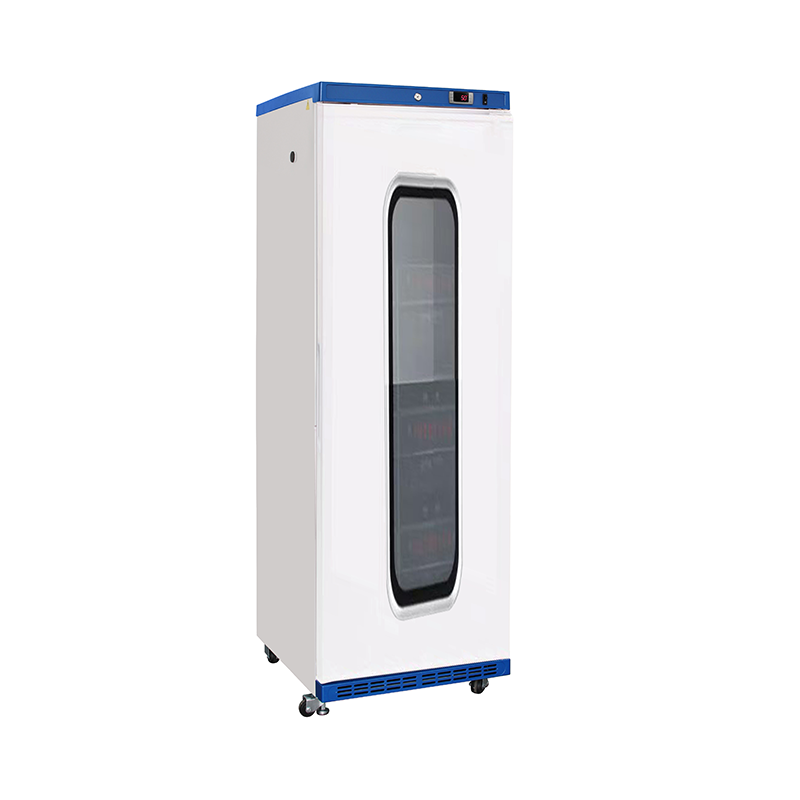
Short answer: procure a blood bank refrigerator from the component, approved storage range, peak bag load, access pattern, monitoring system, alarm response, power-risk plan, and acceptance evidence—not from cabinet litres or a generic “medical refrigerator” label.
Start with the blood component and governing procedure
Whole blood, red-cell components, plasma, platelets, reagents, and patient samples do not automatically belong in the same equipment. Their storage conditions and operating controls can differ, and some require a freezer or platelet system rather than a refrigerator. The responsible blood-service and quality teams should identify the material, approved temperature range, maximum storage period, segregation rules, and applicable national requirements before a supplier proposes a model.
WHO’s blood cold-chain procurement guide describes dedicated equipment and performance concepts for blood programmes. Its published specifications are useful technical references, but the guide dates from 2002. Buyers should use current national rules, component instructions, quality-system procedures, and the latest applicable standards as the controlling requirements.
1. Define capacity in bags and workflow—not litres alone
Record the peak quantity for every bag type, its filled dimensions, delivery and issue pattern, quarantine stock, emergency reserve, and expected growth. Translate this inventory into a shelf or drawer layout using the exact internal dimensions. Allow for air circulation, sensor locations, dividers, labels, inspection, and picking without prolonged door opening.
| Procurement input | What to define | Evidence to request |
|---|---|---|
| Component and pack | Component type, bag size, orientation, secondary packaging | Approved storage procedure and measured pack dimensions |
| Peak load | Routine peak, emergency reserve, quarantine, returned units | Inventory history and proposed loaded layout |
| Access pattern | Issues per shift, door openings, authorized users | Drawer or shelf arrangement and access simulation |
| Segregation | Status, blood group, site policy, restricted stock | Labelled zones, dividers, locks, and workflow drawing |
Ask for both the stated cabinet volume and the model-specific maximum bag capacity under the proposed layout. Neither number proves that the real load fits safely; the buyer should approve a practical arrangement before ordering.
2. Compare temperature evidence under declared conditions
A setpoint or display range is not evidence of loaded-cabinet performance. Request the test method, ambient condition, loading state, sensor positions, stabilization period, uniformity results, recovery method, and treatment of door openings. Confirm which results apply to the exact cabinet, controller, shelves or drawers, and power configuration being quoted.
Separate control, display, recording, and independent monitoring. Ask which sensor performs each function, where it is located, how it is calibrated, what resolution is displayed, and how records are exported. Where the quality system requires temperature mapping, agree the protocol, acceptance limits, load state, instrument accuracy, and report ownership before commissioning. WHO’s temperature-mapping guidance provides a structured methodology, but the facility must approve the protocol for its own regulated use.
3. Write an alarm and escalation matrix
List the events that require local or remote action: high and low temperature, door open, power failure, sensor fault, controller fault, communication loss, and low backup battery where applicable. For each event, define the threshold, delay, audible and visible indication, acknowledgement, reset behaviour, retained record, remote recipient, and escalation time.
Verify what remains available without mains power. Cooling holdover, controller display, local alarm, data logging, network gateway, and remote notification can have different backup durations. Connect every technical alarm to a written response: who assesses the load, who authorizes transfer or quarantine, which alternative storage is available, and how the decision is recorded.
4. Evaluate cabinet construction and daily operation
- Access and security: door or drawer arrangement, lock control, audit expectations, and visibility of stored units.
- Cleanability: internal materials, removable fittings, spill access, and cleaning instructions compatible with the facility procedure.
- Airflow protection: loading limits and clearances around ducts, fans, walls, doors, and sensors.
- Records: device identity, measured value, event history, timestamp, export format, retention, user access, and clock management.
- Serviceability: condenser access, preventive maintenance, local technical support, spare parts, response time, and warranty exclusions.
A feature should be scored only if it is standard on the quoted model or separately priced and documented. Ask the supplier to identify every optional alarm contact, recorder, gateway, drawer, voltage accessory, or backup-power component.
5. Plan power, room conditions, and continuity
Confirm voltage, frequency, plug or hard-wiring requirements, circuit protection, earthing, maximum current, and compatibility with the facility’s backup supply. Record realistic room-temperature extremes, ventilation clearances, heat rejection, direct sunlight, moisture, dust, service space, and the delivery route. Do not assume air conditioning or a generator is continuously available unless that assumption is supported by the site plan.
The continuity plan should identify an alternate validated storage location and a monitored transfer method. Spare capacity elsewhere is useful only if it is available during the same outage or failure scenario.
6. Put evidence into factory and site acceptance
| Acceptance activity | Example record | Pass condition to agree |
|---|---|---|
| Identity and configuration | Model, serial number, controller, shelves or drawers, accessories | Matches the approved order and drawings |
| Installation | Supply, clearances, level, door operation, monitoring placement | Meets the manufacturer instructions and site requirements |
| Temperature study | Approved stabilization, mapping, or verification report | All agreed positions meet the approved limits |
| Alarm challenge | Safe simulation and notification record | Correct event, delay, recipient, record, and reset |
| Power interruption | Approved outage test or model evidence | Behaviour and backup duration match the specification |
| Handover | Manuals, calibration records, training, service contacts | Quality and operating owners sign acceptance |
Do not use stored blood to create an unsafe challenge. Test methods should be approved by the facility, equipment supplier, and responsible quality personnel. The cabinet should enter service only after deviations are resolved or formally accepted and the required monitoring record is complete.
Questions to include in a supplier comparison
- Which blood component and storage procedure is the proposed model intended to support?
- How many of the buyer’s actual bags fit in the approved loaded layout?
- What test evidence supports temperature performance at the intended ambient condition?
- Which monitoring, alarm, recording, and remote-notification functions are standard?
- What happens to cooling, records, and alarms during loss of power or communication?
- What commissioning, mapping, training, maintenance, and calibration services are included?
Compare the Roundfin blood bank refrigerator range, then use the alarm specification checklist and installation readiness checklist. For a model discussion, send the component, approved range, peak bag load, destination, power supply, and monitoring requirements.
Official references
- WHO: The blood cold chain—guide to the selection and procurement of equipment and accessories
- WHO: Safe blood and blood products—management, maintenance and use of blood cold-chain equipment
- WHO TRS 1060, Annex 4: Good practices for blood establishments
- WHO: How to temperature map cold-chain equipment and storage areas